Commercial EV charging stations are becoming practical assets for offices, hotels, retail sites, and fleet depots. They give drivers a place to recharge while they work, shop, stay overnight, or complete deliveries. The value is not simply a row of plugs. It can include longer customer visits, added convenience for employees, and more predictable charging for company vehicles. Small details matter: a clearly marked parking bay, a working payment screen, and a charger near the building entrance can shape the whole experience.
So, what are the benefits of commercial charging stations? Dr. Gil Tal, director of the Plug-in Hybrid & Electric Vehicle Research Center at the University of California, Davis, studies how charging access affects electric-vehicle use. His research offers a useful guiding idea: charging works best when it fits people’s real routines. That is a paraphrase, not a direct quotation. For businesses, the point is concrete. A hotel guest may plug in overnight; a delivery van may charge during a scheduled break. The right setup depends on who uses the site and when.
There are trade-offs, too. Installation costs, available electrical capacity, maintenance, and charger use all deserve careful review. A station that looks impressive but sits idle is not a strong investment. Nor does every location need the same number or type of chargers. This guide examines the main benefits, practical planning choices, and common limits of commercial EV charging in 2026. The details can be unglamorous. They still matter.
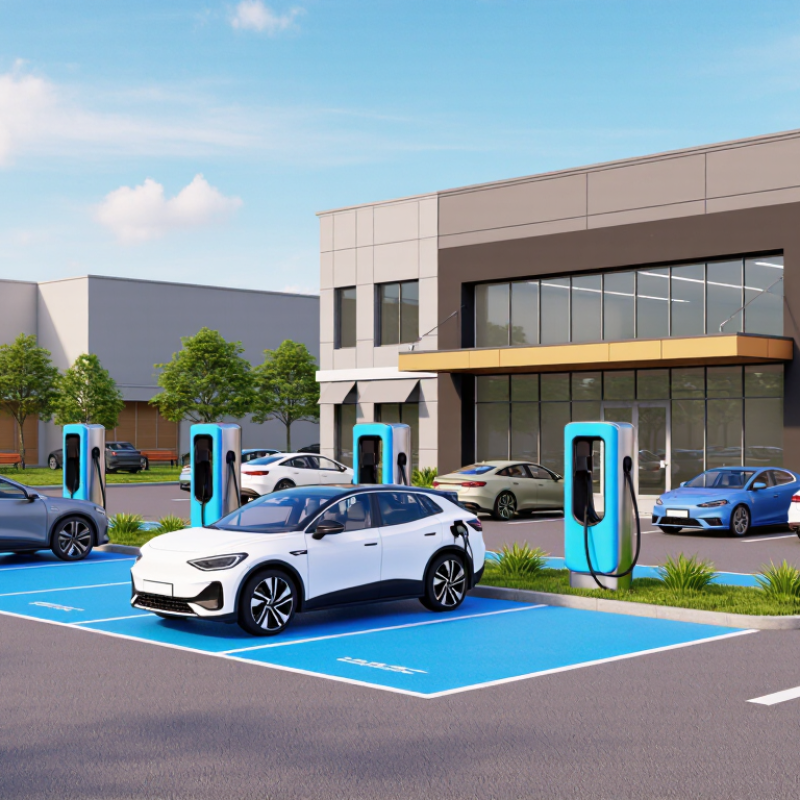
Commercial EV charging stations are equipment installed at workplaces, retail sites, parking facilities, and fleet depots. They connect a building’s electrical supply to an electric vehicle through charging cables and protective controls. Drivers may start a session with a payment method, access card, or fleet account. The station then checks the connection and manages power delivery.
With Level 2 charging, alternating current flows to the vehicle, where its onboard charger converts it to battery-ready direct current. DC fast chargers perform that conversion inside the station, allowing higher power delivery. The U.S. Department of Energy’s Alternative Fuels Data Center lists typical Level 2 power at 2.9–19.2 kW and DC fast charging at 50 kW or more. Actual charging speed varies with the vehicle, battery temperature, and site capacity. That distinction matters.
Commercial systems can share available power across several plugged-in vehicles, helping avoid unnecessary electrical upgrades. Yet a full parking lot does not guarantee fast charging: building demand and charging schedules still compete for capacity. The International Energy Agency’s Global EV Outlook 2024 reported more than four million public charging points worldwide in 2023, with fast-charging points growing about 55% that year. For operators, the practical work begins with matching charger type, electrical capacity, and typical parking time. A rushed installation can leave expensive equipment underused.
On-site charging changes how fleets and workplaces plan each day. Vehicles can plug in near their usual parking spaces, rather than making separate trips to public chargers. A depot supervisor can match charging windows to routes, vehicle return times, and expected battery needs. That takes coordination. But it can make morning departures more predictable.
For example, a delivery van returning at 4 p.m. might charge before its next early shift. Staff vehicles can use different bays during the workday, with clear signage showing who should move when. Charging data can also help managers spot recurring bottlenecks, such as several vehicles needing power before the same shift. Small operational details matter. A cable across a walking route, or a bay blocked by a parked car, can undo a tidy plan.
Workplace charging may support employee convenience, too. People can arrive, park, and connect without changing their commute routine. Fleet and employee demand should be considered separately, though; shared chargers can create friction when priorities are unclear. Capacity planning is not perfect on day one. Managers may need to review arrival patterns, charging sessions, and vehicle assignments over several weeks, then adjust schedules or access rules. A simple operating plan, updated as real use becomes visible, is often more useful than assumptions made before installation.
Commercial EV charging stations can give drivers a practical reason to stop near local shops, cafés, and service businesses. A customer might plug in, order lunch, and browse nearby stores while the vehicle charges. Even a short visit can introduce people to businesses they had not planned to visit. But extra foot traffic is not guaranteed; location, charger reliability, and nearby services all matter.
Charging can also make a business feel more useful to local residents. Offices, hotels, and retail sites may offer charging as an added convenience, while nearby businesses benefit when drivers spend time in the area. Clear signs, comfortable seating, and easy-to-find restrooms help turn waiting time into a better visit. Small details count. Still, installation alone does not create a welcoming destination. A slow repair response or confusing payment instructions can frustrate visitors, and operators should review usage data before expanding.
Tips: Place chargers where visitors can see them, but keep parking and pedestrian routes clear. Post simple instructions and check equipment regularly. Ask customers what would improve their stop; the answers may be less obvious than expected.
Commercial EV charging stations can help businesses cut transportation emissions by replacing gasoline use with electricity. The exact reduction depends on how that electricity is generated. Charging during periods with more renewable power can improve the result. So can pairing chargers with on-site solar, where practical. For a delivery fleet, the change is visible: fewer fuel stops and quieter vehicles returning to the depot. But installing chargers alone does not make a fleet cleaner. Vehicle use and local grid conditions matter.
Electricity may also cost less than fuel, especially when charging is scheduled for lower-rate hours. Smart charging can stagger vehicles instead of drawing maximum power at once, helping control peak demand charges. A business can review utility bills, charging records, and vehicle mileage to check whether savings are real. Results vary by tariff, charger use, and installation costs. Some sites may need upgrades, and that can weaken the payback. It is easy to overlook.
Tips: Start with a few chargers and track energy use by vehicle. Set charging schedules around actual departure times, not guesswork. Recheck costs after several billing cycles; early estimates can miss peak charges.
| Benefit / metric | Illustrative baseline | EV charging scenario | Estimated result | Important considerations |
|---|---|---|---|---|
| Operational emissions per mile | Gasoline vehicle: 28 miles per gallon; gasoline combustion emits about 8.887 kg CO2 per gallon. | EV uses 0.30 kWh per mile; illustrative electricity-grid intensity is 0.40 kg CO2 per kWh. | About 62% lower tailpipe-and-electricity operational CO2 per mile in this example: approximately 0.12 kg for the EV versus 0.32 kg for the gasoline vehicle. | Actual EV emissions depend on the local electricity mix and charging time. This comparison excludes vehicle and battery manufacturing. |
| Annual emissions avoided per vehicle | 12,000 miles per year in a 28-mpg gasoline vehicle: approximately 3.81 metric tons of tailpipe CO2. | The same annual mileage in an EV at 0.30 kWh per mile and 0.40 kg CO2 per kWh: approximately 1.44 metric tons of electricity-related CO2. | Approximately 2.37 metric tons of CO2 avoided per vehicle per year under the stated assumptions. | This is an illustrative operating-emissions estimate, not a guaranteed reduction. Regional grid emissions and actual vehicle efficiency can change the result. |
| Energy cost per mile | Gasoline at $3.30 per gallon and 28 miles per gallon: approximately $0.118 per mile. | Electricity at $0.13 per kWh and 0.30 kWh per mile: approximately $0.039 per mile. | About 67% lower energy cost per mile, or roughly $0.079 saved per mile in this example. | Illustrative prices only. Electricity tariffs, fuel prices, charging losses, and demand charges vary by location and account. |
| Annual energy-cost savings per vehicle | 12,000 miles per year at approximately $0.118 per mile: about $1,414 in gasoline. | 12,000 miles per year at approximately $0.039 per mile: about $468 in electricity. | Approximately $946 per vehicle per year in energy-cost savings before charging-station and other costs. | Does not include charger purchase, installation, maintenance, financing, or utility demand charges. A site-specific tariff analysis is recommended. |
| Potential fleet-scale impact | 100 vehicles, each traveling 12,000 miles annually in the gasoline-vehicle baseline above. | 100 comparable EVs charged using the illustrative electricity assumptions above. | About 237 metric tons of operational CO2 avoided and approximately $94,600 in annual energy-cost savings across the fleet. | Fleet totals scale the per-vehicle illustration; actual results depend on mileage, vehicle efficiency, electricity rates, and local grid emissions. |
| Energy management opportunity | Unmanaged charging may concentrate electricity use during high-demand periods. | Smart charging can schedule sessions, balance charging loads, and prioritize off-peak periods where the utility tariff allows. | Potential for better load management and lower electricity costs when supported by suitable tariffs and site controls. | Savings are not automatic; they depend on the utility rate, charging patterns, available capacity, and any demand-charge rules. |
| Methodology note: Figures are transparent illustrative estimates, not a forecast or quotation. Calculations use 8.887 kg CO2 per gallon of gasoline, a 28-mpg gasoline vehicle, EV consumption of 0.30 kWh per mile, an example grid intensity of 0.40 kg CO2 per kWh, gasoline at $3.30 per gallon, electricity at $0.13 per kWh, and 12,000 miles per year. Emissions and energy-price factors vary by region and over time. Reference factors: U.S. EPA gasoline emissions and eGRID regional electricity data; U.S. Energy Information Administration retail energy-price data. | ||||
Smart charging helps commercial EV stations grow without forcing every site to build for its busiest hour. The International Energy Agency reported that more than 1.3 million public charging points were added worldwide in 2023, bringing the total to over four million. For businesses, that expansion makes thoughtful energy management increasingly important. A workplace garage can stagger vehicle charging after arrival, while a delivery depot can prioritize vans scheduled for early departures.
Small timing changes matter.
Connected chargers can shift sessions away from expensive peak periods, monitor equipment, and share available power across parking bays. The U.S. Department of Energy’s Alternative Fuels Data Center describes managed charging as a way to coordinate charging with grid conditions and electricity prices. That supports more predictable operating costs and may delay costly electrical upgrades.
But software cannot fix an undersized service panel. Not automatically. Businesses should review site capacity, vehicle schedules, and utility rates before installation. Some forecasts will be wrong; real charging data can help refine the plan.
Sources: IEA, Global EV Outlook 2024; U.S. Department of Energy, Alternative Fuels Data Center.
It connects a building’s electrical supply to vehicles through cables and protective controls. Drivers may use a payment method, access card, or fleet account. Simple enough.
Level 2 sends AC to the vehicle, where its onboard charger converts it for the battery. DC fast chargers convert power inside the station and can deliver more power. Actual speed depends on the vehicle, battery temperature, and site capacity.
Yes. Systems may share available power across plugged-in vehicles, reducing pressure for electrical upgrades. However, building use and charging schedules also draw power. A busy lot may still charge slowly.
Operators should compare charger type, electrical capacity, and typical parking time. A workplace with long stays may need a different setup from a quick-stop retail lot. Rushing can leave equipment underused.
Not necessarily. Drivers might charge while eating lunch or browsing nearby stores, but extra visits depend on location, reliability, and nearby services. The hope is understandable; the result needs checking.
Visible placement, clear signs, comfortable seating, and nearby restrooms can improve a stop. Keep pedestrian paths and parking routes open. Little details matter.
Check equipment regularly, provide simple payment instructions, and respond quickly to repairs. Review usage data before expanding, and ask customers what would help. Their answers may surprise you; ours may miss something.
Commercial EV charging stations provide businesses with a practical way to supply electricity to electric vehicles while supporting daily operations. They connect vehicles to the power grid and deliver energy at a rate suited to the equipment and vehicle, with smart systems able to monitor usage and manage charging schedules. For workplace fleets, on-site charging can make it easier to keep vehicles ready, reduce trips to public chargers, and coordinate charging around work shifts. Employees may also value convenient charging while they are at work.
What are the benefits of commercial charging stations for local businesses? They can give customers another reason to visit and stay longer, while supporting nearby shops and services. Charging electric vehicles can also help reduce tailpipe emissions, and businesses may lower energy expenses by scheduling charging during less costly periods or using available on-site energy resources. As electric vehicle adoption grows, smart charging systems can help businesses track demand, make better use of electrical capacity, and expand charging access over time.

VoltEdge Charging